Scaling Small Business Operations: Build vs. Buy vs. Base44
Scaling your small business requires intelligent automation. We break down the trade-offs between manual integration, legacy platforms, and the Base44 full-stack approach.
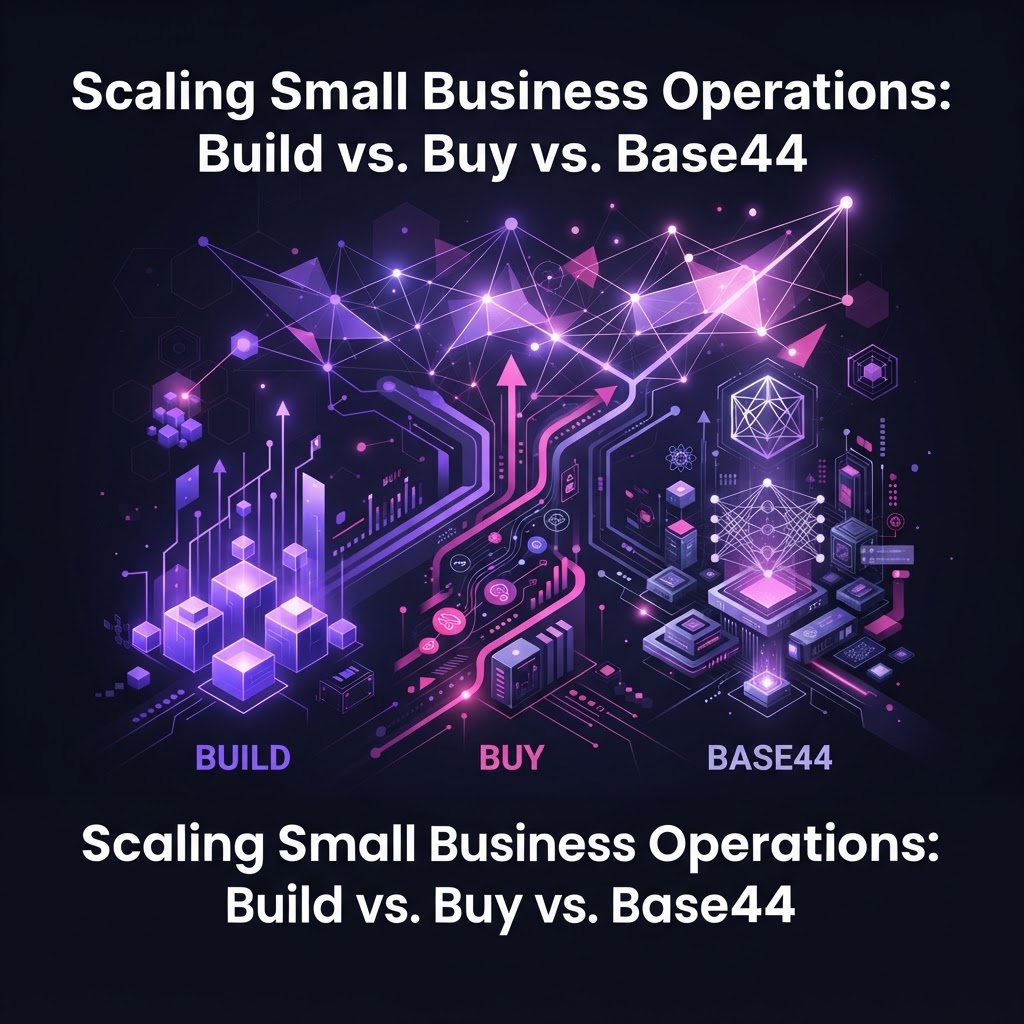
The Automation Dilemma
For small business owners, the 'automation tax' is real. Most businesses struggle by gluing together incompatible legacy tools, wasting hours on manual data entry, or paying exorbitant fees for custom software development that never seems to finish. To scale effectively, you need a different approach.
Three Approaches to Automation
1. The 'Patchwork' Strategy (Zapier/Make + Legacy Tools)
This involves connecting existing SaaS apps via third-party middleware.
- Pros: Fast to set up for simple tasks like email notifications or basic list syncing.
- Cons: Fragile. Every API update breaks your workflow. You lack a unified database, making it nearly impossible to implement complex Role-Level Security (RLS) or internal logic.
2. Custom Development (Hard-Coded Solutions)
Building from scratch with a dedicated engineering team.
- Pros: Full control over every pixel and data point.
- Cons: Prohibitively expensive and slow. Maintenance is a constant drain on your resources.
3. The Full-Stack AI Approach: Base44
Base44 changes the paradigm by using natural language to build production-grade, full-stack applications.
Instead of patching together separate tools, Base44 provides a managed backend, authentication, and a visual editor for business apps, CRMs, or inventory systems. You aren't just automating a process; you are building the infrastructure that runs it.
Why Base44 Wins for Speed
Base44 accelerates product delivery by handling the heavy lifting of modern development:
- Typed Data Models: Define your entities as JSON schemas, ensuring data integrity from the start.
- Intelligent Workflows: Trigger-driven automation based on entity events or scheduled cron jobs, coupled with durable steps using
call,wait, andswitchlogic. - Powerful AI Integration: Use
InvokeLLMwith support for models likegpt_5_5orclaude_sonnet_4_6to process data directly against your entities. - Native Mobile: Deploy your internal tools or customer portals to iOS/Android from a single codebase.
The Takeaway
Stop duct-taping legacy software. Whether you are automating your CRM via HubSpot connectors or building custom AI Superagents to manage your operations, the goal should be a unified architecture. By moving to a platform that handles your backend, auth, and logic, you can transition from simply 'automating tasks' to building a scalable business ecosystem in minutes.