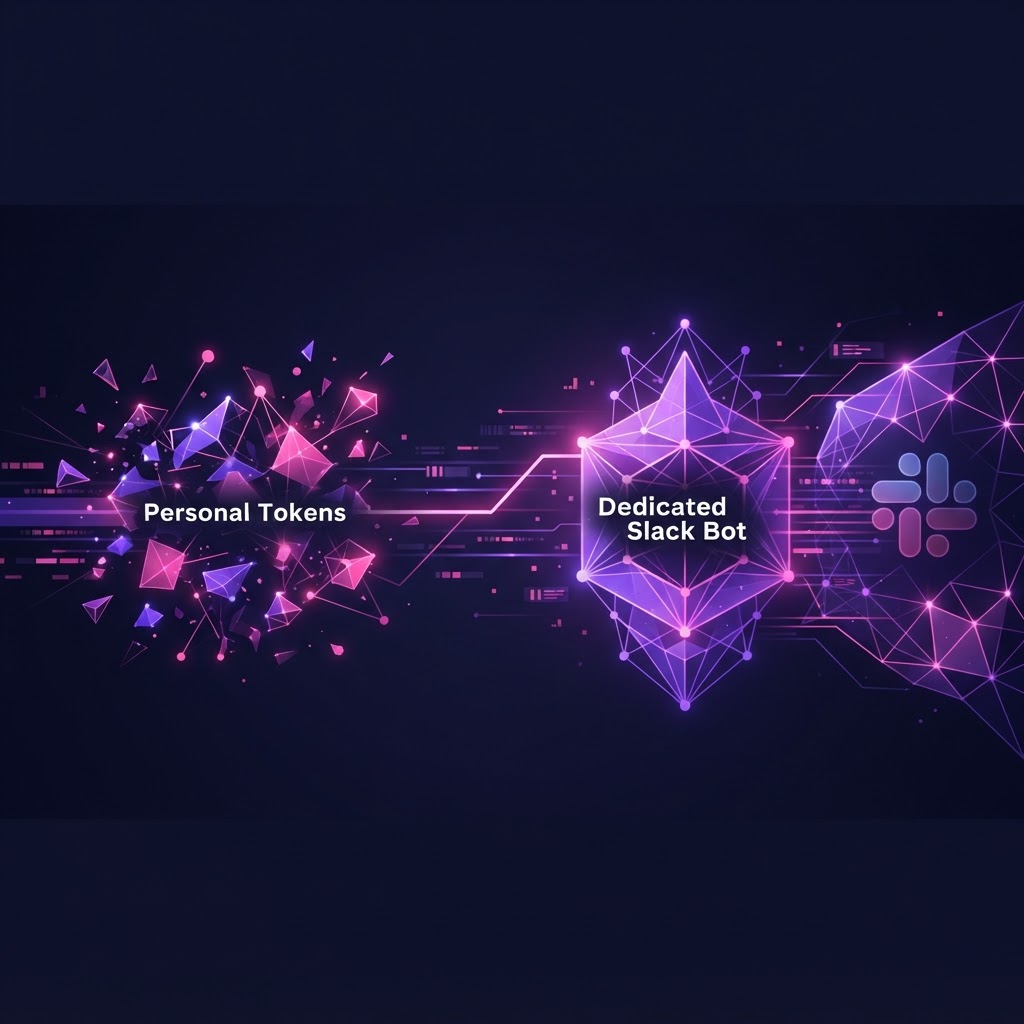
Stop Using Personal Tokens: The Founder’s Guide to Professional Slack Bots
Personal Slack tokens are a liability for your business apps. Learn why switching to dedicated Slack Bot connectors is the essential step to scaling your automated infrastructure.
The Hidden Risk of 'It Just Works' If you are building automated workflows for your startup, you have likely hit that moment of frustration where you need to get data out of your app and into your Slack workspace. The path of least resistance? Generating a personal Slack token, pasting it into a script, and calling it a day. It works in five minutes. But here is the cold truth: it is technical debt disguised as convenience. As a founder, you are not just building features; you are building systems. Using personal tokens for app notifications ties your business-critical alerts to your individual Slack identity. If you leave the company, rotate your personal password, or hit a permission wall, your automation pipeline snaps. Professionalizing your automations means moving away from personal identification and toward dedicated Slack Bot connectors. ## Why Dedicated Bots Are the Standard Professionalism is about isolation and control. A dedicated Slack bot acts as a formal interface between your platform and your team. By using a proper Slack Bot connector, you gain: 1. Identity Separation: The bot is its own entity in your workspace, identifiable by your team as a service, not a person. 2. Granular Permissions: You define exactly what the bot can do—post messages, read threads, or interact with workflows—without granting it full access to your personal account history. 3. Auditability: When a notification arrives, you know it came from your app's system logic, not a script running on your local machine. ## Integrating Slack into your Base44 Architecture At Base44, we built our integration architecture to make this transition frictionless. When you use the Base44 Slack connector, you are not just passing strings of text; you are integrating a managed OAuth flow that ensures your connection is secure, persistent, and authorized as a service app. Whether you are using Base44's entity CRUD events (like triggering a Slack message when a new record is created via base44.entities.EntityName.create) or building complex AI agents, you should be routing these through the dedicated bot connector. Instead of managing static keys, Base44 handles the authentication lifecycle for you. This allows your app to scale alongside your product without the constant fear that your 'quick fix' code will break because of an expired token. ## Moving Beyond Simple Notifications The real power happens when you combine these bots with Base44 Workflows. Once you have a dedicated bot, you can stop treating Slack as a one-way street. Use invoke_backend_function to push data from your database to Slack, or leverage our AI agents to perform proactive operations. Imagine an AI agent, triggered by a webhook, that summarizes a new entry in your CRM and posts a formatted update to a dedicated #sales-leads channel via your bot. Because the bot is authenticated through the proper connector, the agent has the necessary permissions to perform these actions consistently, 24/7, without requiring your active Slack session to be logged in. ## The Founder’s Takeaway Do not let your infrastructure be a reflection of your lack of time. Switching to dedicated bot connectors is a low-effort, high-impact move that matures your product architecture instantly. If you are building with Base44, use the built-in Slack connector. It takes the heavy lifting of authentication off your plate so you can focus on building the features that actually move the needle. Stop patching your notifications with personal credentials. Professionalize your stack today.