Stop Building Monolithic AI Agents: Why Sub-Agent Architectures are the Future
Scaling AI automation requires moving beyond single-prompt solutions. Here is how I use Base44 to build modular sub-agent architectures for robust, specialized workflows.
The Problem with the 'Do-It-All' Prompt
When I first started shipping AI-powered tools, I fell into the trap of the 'God Prompt.' I wanted a single AI agent that could handle customer support, log data into a CRM, and draft follow-up emails. It worked—until it didn't. The complexity grew, the latency spiked, and the hallucinations increased because the context window was cluttered with irrelevant instructions for the task at hand.
In the world of fast-paced product building, monolithic agents are a liability. If you want to scale your automation, you have to embrace a sub-agent architecture.
The Sub-Agent Philosophy
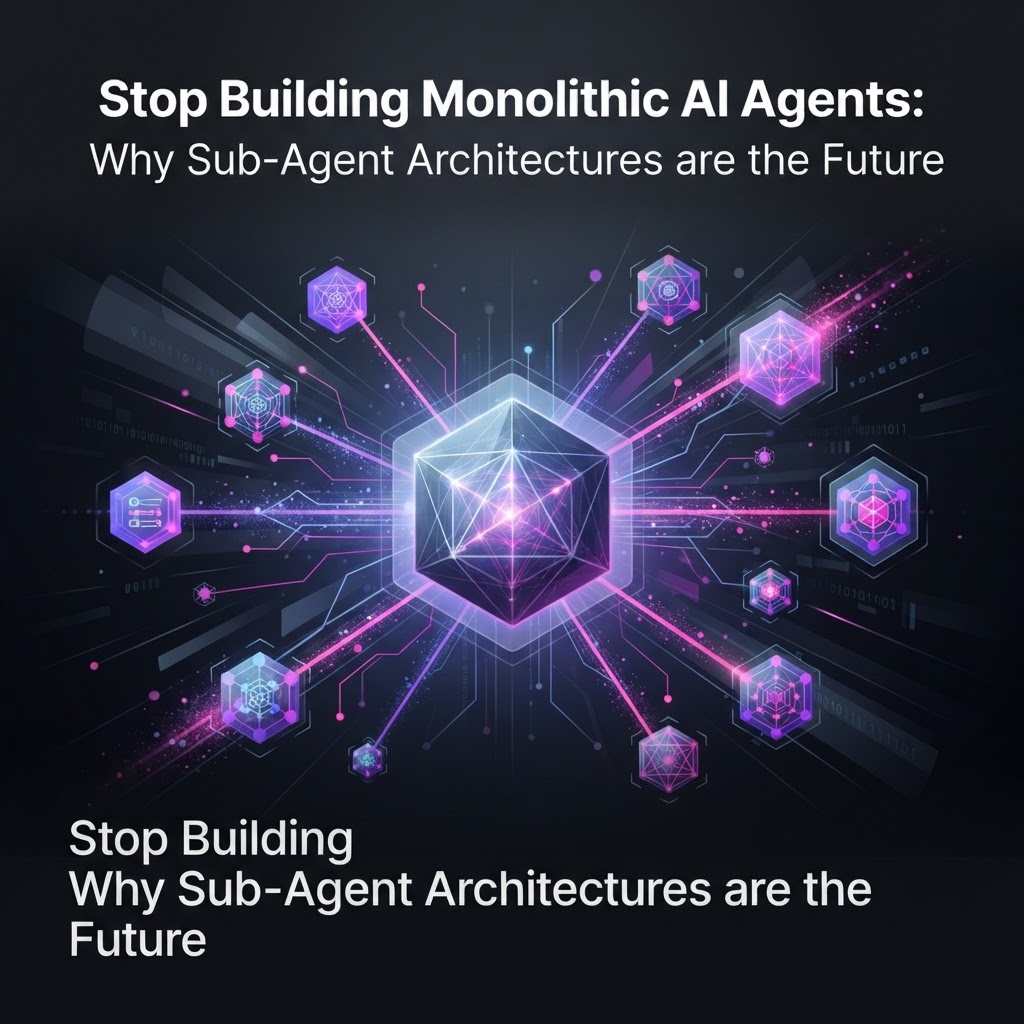
Think of a sub-agent architecture like a well-managed software team. Instead of one developer trying to handle infrastructure, design, and marketing, you have specialists. In Base44, I implement this by decoupling the 'manager' agent from the 'execution' agents.
Using Base44's AI agents, I define specialized workers that only have access to specific tool permissions. For example, my 'Researcher Agent' has access to InvokeLLM with add_context_from_internet enabled, while my 'CRM Updater Agent' is restricted solely to base44.entities.Lead.update and base44.entities.Lead.create operations. By limiting the tool set, I reduce the risk of the agent executing unauthorized actions and drastically improve the reliability of the structured JSON output.
Designing Your Workflow Pipeline
When I build these, I lean heavily on Base44 Workflows. A typical flow looks like this:
- The Orchestrator: An in-app agent receives a user request. It analyzes the intent and determines which sub-agent is required.
- The Switch: I use the
switchactivity withjqconditions to route the payload to the appropriate backend function. - Specialized Execution: The sub-agent performs its task. If it needs external data, it calls
InvokeLLMwith specific models likeclaude_sonnet_4_6for reasoning orgpt_5_4for structured formatting. - Data Persistence: The sub-agent writes the result back into the database using the Base44 entity SDK (e.g.,
base44.entities.Task.create).
Why This Scales
By leveraging the Base44 managed backend and Row-Level Security (RLS), I don't have to worry about the underlying infrastructure of these handoffs. When a 'Research' agent fetches data via a connector—like Notion or HubSpot—it leaves a trail. If something goes wrong, I know exactly which sub-agent failed because I isolated its scope.
Furthermore, because Base44 allows me to ship to iOS/Android and web from the same codebase, my sub-agents are platform-agnostic. Whether the user triggers an action via WhatsApp or through the internal web dashboard, the agentic logic remains identical.
Takeaway
Don't try to build a smarter agent; build a smarter system of agents. By offloading specialized tasks to dedicated, limited-access sub-agents, you reduce maintenance overhead and improve performance. Use your 'Manager' agent to delegate, and use your 'Sub-agents' to execute. Keep your logic modular, keep your tool permissions tight, and you'll find you can ship complex automations significantly faster than your competitors.