Stop Building Monolithic AI Agents: How to Scale with Sub-Agent Architecture
Move beyond single-prompt limitations. Learn how to architect robust AI workflows using specialized sub-agents in Base44 for superior performance and reliability.
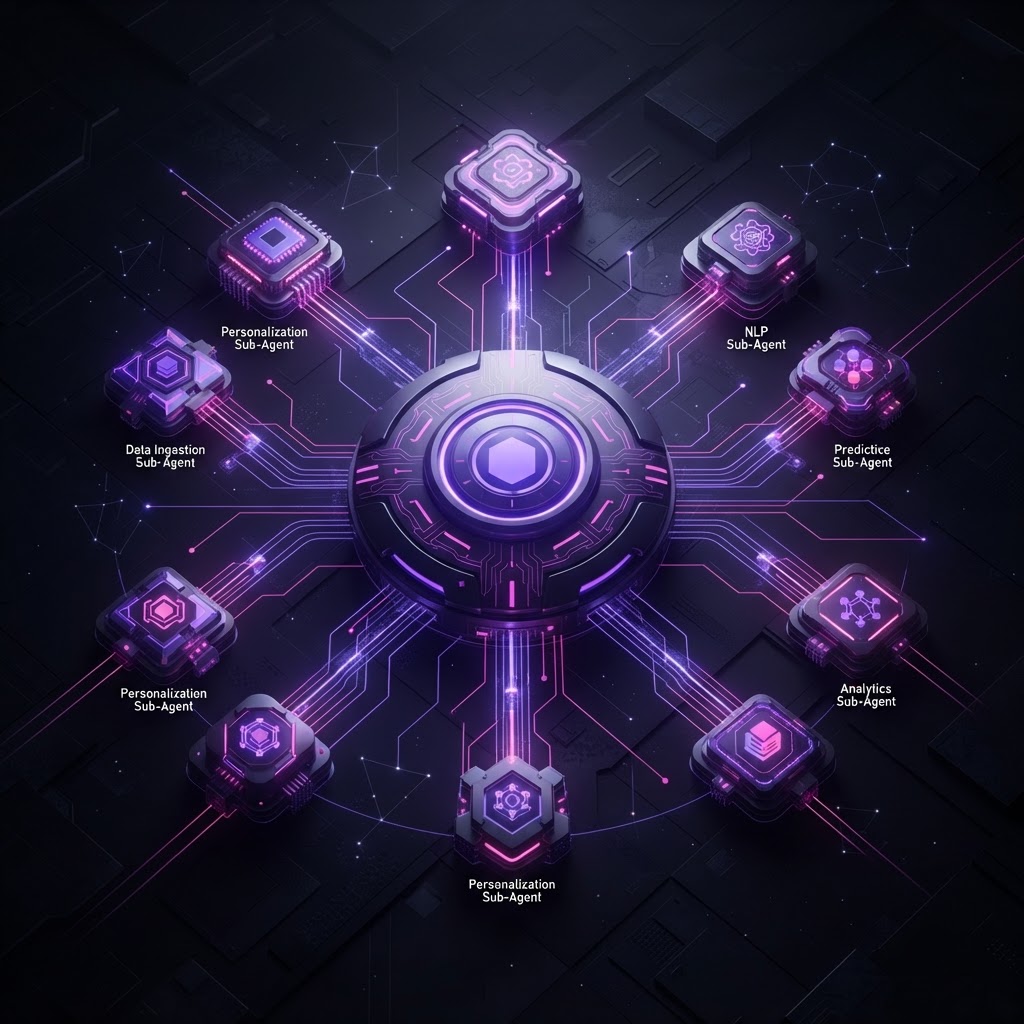
Most developers building AI products start with one big prompt. They try to cram reasoning, data extraction, and tool execution into a single Claude or GPT call. It works until it doesn’t. Once your complexity grows, your error rate spikes and your latency becomes unusable. At Base44, we see this pivot point often: the transition from a 'smart chat' to a real production-grade AI system. To scale, you need to abandon the monolithic agent and adopt a Sub-Agent Architecture. Instead of one agent doing everything, you deploy specialized units that handle discrete parts of your workflow. Here is how to break it down.
Approach 1: The 'Manager-Worker' Pattern (The Superagent Model)
This is the gold standard for complex business processes. You create a 'Superagent'—a high-level orchestrator—that doesn't actually perform the task. It only decides who should do the task. In Base44, you can leverage our Workflow engine to handle the branching logic via switch steps with jq conditions. The Superagent evaluates the user request and routes it to a specific sub-agent (e.g., a 'Researcher' sub-agent that uses add_context_from_internet via InvokeLLM versus a 'Data Entry' sub-agent that performs base44.entities.EntityName.create).
Pros: High reliability. If the 'Researcher' fails, the 'Data Entry' logic is unaffected. It’s modular and easier to debug. Cons: Increased latency due to the orchestration overhead. You are adding tokens for the manager's decision-making process.
Approach 2: The 'Task-Chaining' Pipeline
In this approach, you create a linear sequence of specialized agents. Each agent consumes the output of the previous one. Think of it like a factory line: Agent A extracts data from a file using ExtractDataFromUploadedFile, passes that JSON to Agent B for validation against your defined entity schema, and Agent C uses that data to perform a base44.entities.updateMany operation.
Pros: Extremely predictable. Since each agent is tuned for one specific task, you can use specialized models (e.g., gemini_3_flash for speed, claude_opus_4_8 for complex reasoning) per step.
Cons: If a middle link breaks, the whole chain fails unless you implement robust error handling using our durable wait and call workflow steps.
Building for Production with Base44
The secret to making this architecture work is the underlying infrastructure. When you use Base44, you aren't just stitching APIs together; you have a managed backend with built-in RLS (Row-Level Security). This is critical for sub-agents. You can define specific permissions so that your 'Billing Agent' can access Stripe entities, but your 'Social Media Agent' is restricted to public content entities. This security-first approach allows you to deploy agents that interact with sensitive tools like HubSpot or Salesforce without exposing your entire database to a single failure point.
The Takeaway
Don't force one model to be your entire engineering team. Delegate. By using Base44’s InvokeLLM for specialized tasks and orchestrating them via our Workflow engine, you move from building scripts to building systems. Start by offloading your most repetitive, high-volume task to a secondary agent today. It will be the first step in turning your product into a true autonomous platform. Scale is not about making your agent smarter; it’s about making your system more modular.