Stop Building Automations, Start Building Workflows
Simple triggers aren't enough for production-grade apps. Learn how to leverage Base44 Workflows to build multi-step, failure-resilient logic that actually scales.
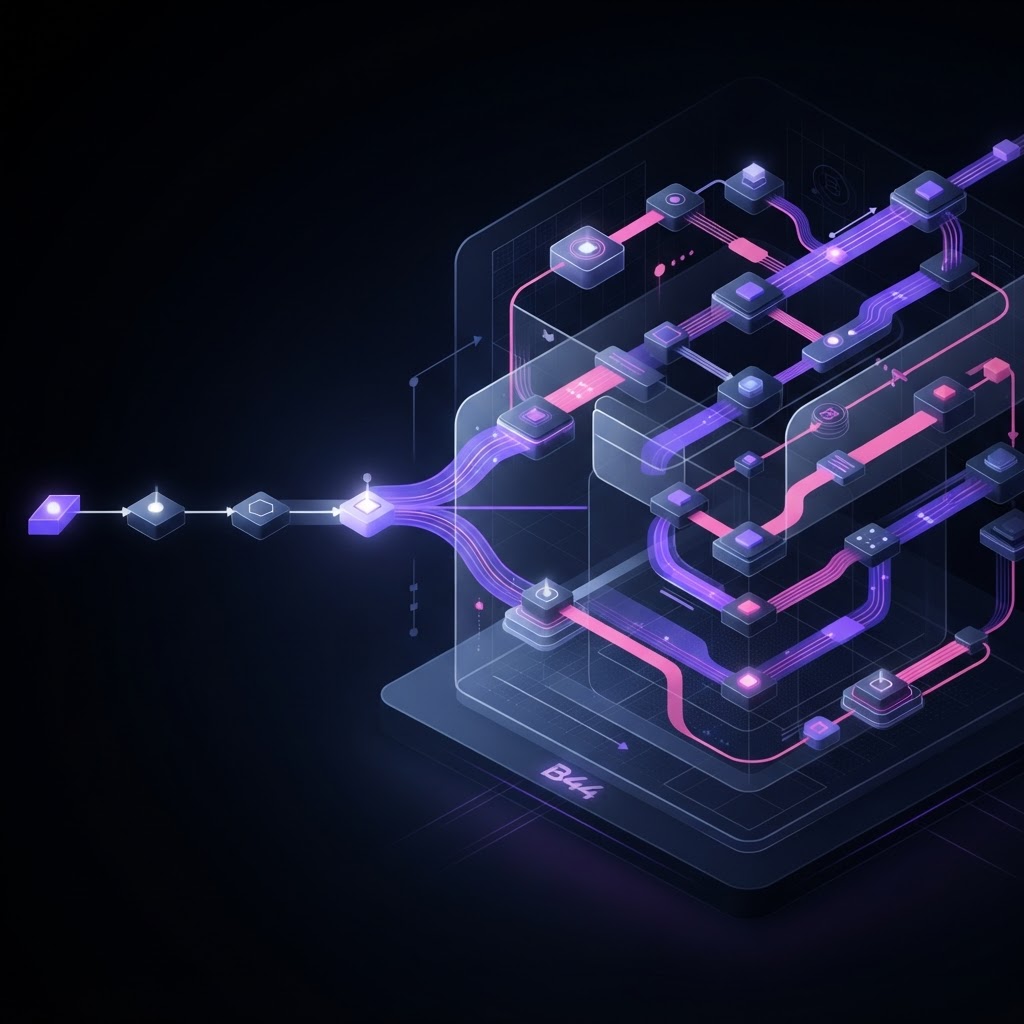
The Trap of 'One-Shot' Automations
When we start building AI products, we often fall into the 'trigger-action' trap. Something happens, an LLM fires, and we call it an automation. But in real-world business apps, things break. If your InvokeLLM call fails or your downstream integration times out, your user experience shouldn't crumble. That is why I have shifted my focus entirely to Workflows.
Moving Beyond Simple Logic
In Base44, Workflows represent the difference between a toy and a product. Unlike simple event hooks, Workflows allow you to orchestrate complex, multi-step operations with native failure protection.
By utilizing the 'step' structure—specifically 'call', 'wait' for durable processing, and 'switch' for branching logic—you can create systems that act like mini-microservices. I use 'switch' blocks heavily to apply jq conditions, ensuring that data flows only where it is validated to go. If a process requires an external API call or a heavy file extraction via ExtractDataFromUploadedFile, you aren't stuck waiting synchronously; you can build resilient, backgrounded logic.
The Anatomy of Resilience
To build for scale, keep these three principles in mind:
- Durable Waits: Use 'wait' steps for processes that bridge time. Don't block your user interface while waiting for a Superagent to perform a multi-channel task via WhatsApp or Telegram.
- Conditional Routing: Don't let your data reach a dead end. Use the 'switch' step to handle errors gracefully. If an InvokeLLM call returns an unexpected schema, branch to a logging step rather than crashing the flow.
- Tight Entity Integration: Use your entity events (create/update/delete) as the primary triggers. By hooking into base44.entities.EntityName operations, your Workflows become state-aware, keeping your backend and UI in perfect sync.
The Founder's Takeaway
Speed of shipping is important, but building systems that require constant manual intervention is a hidden tax on your growth. When you map out your next feature, stop thinking about the 'how'—the AI can handle that through InvokeLLM and agentic memory—and start thinking about the 'what-if'. If you design for failure from the start using Workflows, your product will be the one that stays standing when the edges cases hit.