Stop Building Monolithic AI: The Power of Sub-Agent Architectures
Learn how to move beyond single-prompt limitations by delegating complex workflows to specialized sub-agents using Base44's modular automation framework.
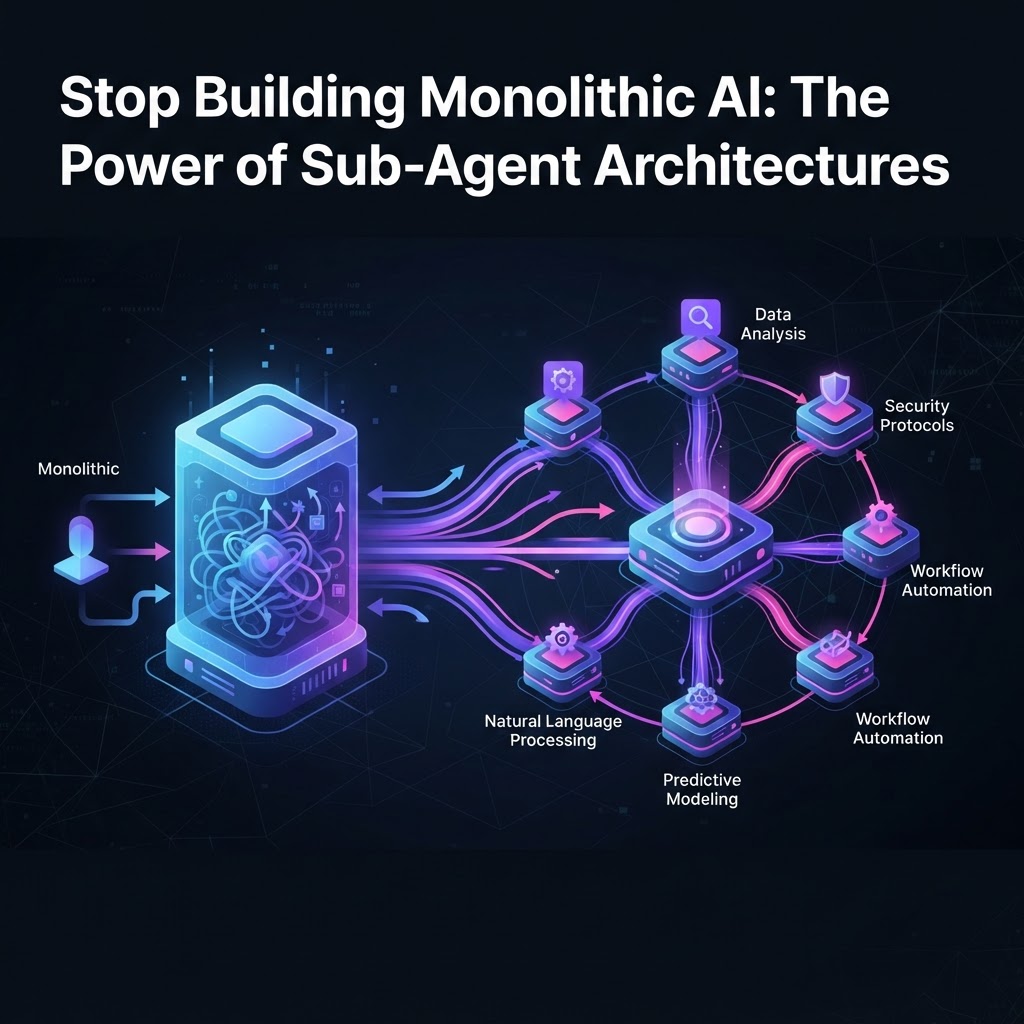
The Bottleneck of the Single Prompt
When we first start building with AI, we fall into a trap. We create a massive, 2,000-word system prompt, feed it every possible contingency, and hope for the best. It works for a simple chat interface, but the moment you try to build a real product—a CRM, an automated booking system, or a complex dashboard—this monolith breaks. It hallucinates, it loses context, and it becomes impossible to debug.
At Base44, we see founders making this mistake every day. They try to make one AI do everything. You don't run a company with one employee, so why would you run your app with one agent? It is time to embrace sub-agent architecture.
What is Sub-Agent Architecture?
Think of your main application as the CEO. It holds the vision and manages the user's intent. But it shouldn't be writing the code, updating the database, and emailing the client all at once. Instead, you delegate these specialized tasks to 'sub-agents.'
In the Base44 ecosystem, a sub-agent is a focused entity with specific permissions, a limited scope of work, and access to only the tools it needs. By offloading 'Research,' 'Data Extraction,' or 'Communication' to distinct agents, you gain reliability and modularity.
Architecting Your First Workflow
In Base44, you aren't just writing prompts; you are building systems. To implement this architecture, we lean on the platform's Workflow engine and the InvokeLLM core integration.
1. Define the Manager (The Brain)
Your main agent evaluates the incoming request. It doesn't need to know how to connect to Salesforce or Slack; it only needs to know who to call. You use the InvokeLLM tool with a structured JSON schema to categorize the task.
2. Provision the Specialists (The Doers)
Instead of building one agent, build three, each with a narrow mandate:
- The Researcher: Has access to
add_context_from_internetandExtractDataFromUploadedFile. - The Operator: Has full CRUD access to your database via
base44.entities. - The Communicator: Manages outbound messaging via
SendEmailorSendPushNotification.
By restricting the 'Operator' agent's permissions to only the entities it needs, you minimize security risks. Using Row-Level Security (RLS) ensures that even if an agent acts on behalf of a user, it cannot access data outside of its assigned scope.
Moving from Scripting to Orchestration
Once you have your specialists, you need a way to chain them. Base44 Workflows act as the nervous system. Using the 'Switch' step—which allows branching via jq conditions—you can dynamically route the output of your 'Researcher' to the 'Operator' if the research is valid, or trigger a human-in-the-loop validation if it isn't.
This is the difference between a prototype and a product. If a step fails, you know exactly which sub-agent dropped the ball. You don't have to rewrite the entire prompt; you just tweak the specific tool or instruction for that one worker.
Why This Scales
- Reduced Hallucinations: Smaller prompts with specific goals stay on track longer.
- Easier Maintenance: If you need to update how your app talks to HubSpot, you modify the HubSpot-specific agent, not your entire core logic.
- Cost Efficiency: You only invoke the 'Claude Opus 4.8' model for the 'Manager' when you need high-level reasoning. For simple database CRUD or email formatting, you can use more cost-effective models like 'Gemini 3 Flash' for the sub-agents.
The Final Word
Stop trying to build the 'perfect' AI agent. Start building a team of agents that work together. Whether you are building an internal tool for inventory management or an external-facing e-commerce portal, the structure remains the same: Orchestrate, Delegate, Execute.
When you build on Base44, you aren't just writing code; you are defining a scalable operational architecture. If you're ready to move from 'I have an idea' to 'I have a business,' stop thinking about prompts and start thinking about systems.