Beyond the Single Prompt: Why Sub-Agent Architecture is the Future of AI Products
Stop building brittle single-prompt AI workflows. Learn how to leverage Base44 sub-agent architecture to build modular, autonomous, and scalable AI applications.
The Bottleneck of the Mono-Agent
If you’re still building AI features by dumping a massive, sprawling system prompt into a single LLM call, you are architecting for failure. Early AI development was all about the 'God Prompt'—trying to force a model to handle reasoning, data extraction, formatting, and action in one go. It’s brittle, it’s expensive, and frankly, it’s not how scalable software is built.
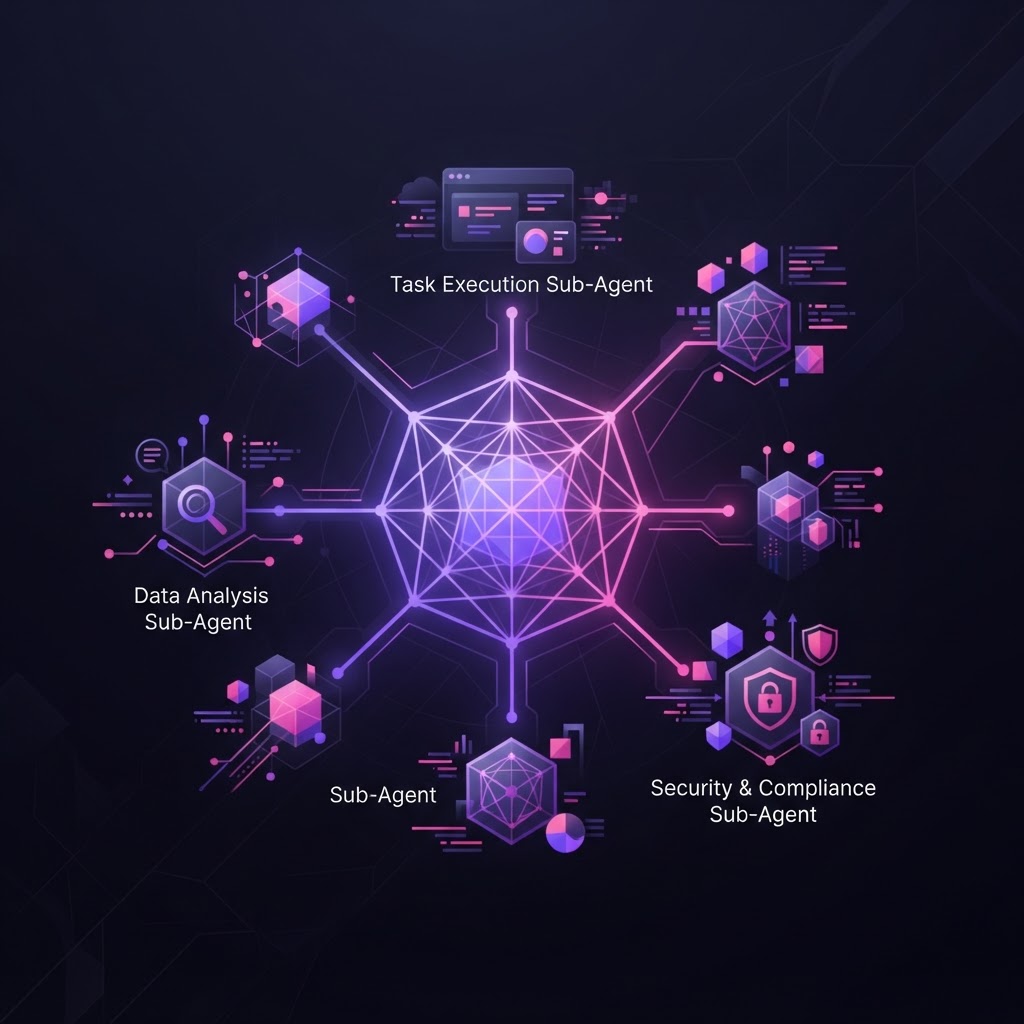
We need to shift from 'Mono-Agents' to 'Sub-Agent Architectures.' In this model, your main application acts as an orchestrator, delegating highly specialized tasks to narrow-focus sub-agents. At Base44, we’ve designed our platform to make this pattern not just possible, but the default way you build high-velocity products.
The Anatomy of Sub-Agent Delegation
Sub-agent architecture works by decomposing your workflow into discrete domains. Instead of one agent trying to manage your CRM, check inventory, and send emails, you build a main Superagent that acts as a manager, delegating to specialized 'worker agents.'
Using Base44's InvokeLLM feature, you can define specific structured outputs using response_json_schema. This is the glue that holds sub-agent architectures together. By enforcing strict schemas, your main agent can pass 'instructions' to a sub-agent and be guaranteed a predictable data structure back.
Defining Specialized Roles
Each sub-agent should have a singular focus. For example, in a complex business application, you might have:
- The Research Agent: Uses
add_context_from_internetto perform live web searches and synthesize current market data. - The Parser Agent: Uses
ExtractDataFromUploadedFileto turn messy PDFs or images into clean, typed JSON. - The Executor Agent: Has limited tool permissions to perform
base44.entities.EntityName.updateor triggerSendEmailworkflows based on the Research Agent’s findings.
By keeping their permissions narrow, you reduce the 'blast radius' of a hallucinations. The Executor Agent doesn't need to know how to search the web; it only needs to know how to write to your Orders entity.
Building Modular Logic with Workflows
Base44 Workflows are the connective tissue for these sub-agents. You aren't just chaining LLM calls; you are managing state. By using switch steps with jq conditions, you can route the output of one sub-agent to the next based on the business logic established in your database entities.
Think of a CRM flow:
- Event Trigger:
base44.entities.Lead.create. - Step 1: Call 'Research Agent' to qualify the lead using web search.
- Step 2: Use a
switch(durable wait) to analyze the score. If high, trigger 'Outreach Agent'. - Step 3: 'Outreach Agent' leverages the
SendEmailconnector to personalize the message.
This is how you build products that feel alive. You’re not just 'using AI'; you’re automating operations.
Security and RLS: The Professional Layer
Scaling AI requires governance. When you delegate tasks to agents, they are acting on your data. This is where Row-Level Security (RLS) becomes your best friend. In Base44, even when an agent is performing a base44.entities.EntityName.list operation, the RLS policy governs what it can see.
By segregating data access via RLS and assigning specific tool permissions to agents, you prevent 'agent drift,' where a sub-agent tries to perform actions outside of its authorized scope. You aren't just shipping code; you're shipping a secure, multi-tenant system.
Looking Ahead: The Agentic Stack
Where is this going? We are moving toward a future where the 'UI' is just the monitoring dashboard for your agent fleet. With Base44, your React + Tailwind frontend is a window into the operations happening in your backend. You’re managing Superagents that oversee hundreds of sub-agent interactions daily.
If you want to move fast, stop trying to build one 'perfect' AI. Start building a fleet of 'good' ones that talk to each other through well-defined entity schemas and structured JSON. The era of the monolith is over; the era of the agentic mesh has begun.
If you have an idea for an agentic workflow, jump into Base44, define your entities, and start building the sub-agents that will actually do the work for you. Stop iterating on prompts and start iterating on systems.